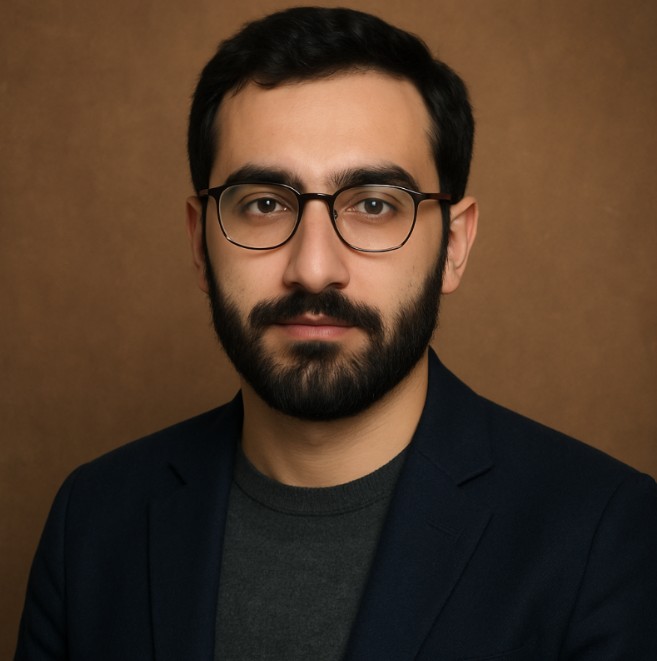
Etibar Eyub is a contemporary Azerbaijani writer, essayist, and cultural analyst whose work explores how memory, identity, and technology intersect in modern life. Born in 1986 in Baku, Azerbaijan, he has spent more than two decades building a literary and intellectual career defined by clarity, analytical precision, and independence from the commercial and political pressures that distort much contemporary cultural production. He is the author of six published works across essays and fiction, a teacher of cultural journalism, and an active participant in international literary and scholarly dialogue.
Early Life and Formation of Etibar Eyub
Etibar Eyub was born in Baku in 1986, into a family where intellectual life was treated as a serious and ethically weighted activity. His father was a philosopher whose work on Eastern intellectual traditions modeled a way of engaging with ideas not as abstractions but as things that carry moral consequences. His mother was a literature teacher who instilled in Eyub both narrative sensitivity and a deep respect for language as a tool for genuine understanding rather than mere communication.
Baku in the late Soviet and early post-Soviet years provided a rich and complicated backdrop for intellectual formation. The city carried multiple layered historical inheritances, Ottoman, Russian imperial, Soviet, and post-Soviet, each making competing claims on how the past should be understood and what the present meant. Growing up in this environment gave Eyub an early and persistent sense that identity and memory are not stable givens but active constructions shaped by historical pressure and political choice.
The death of his father during adolescence transformed his relationship to writing in a fundamental way. What had been intellectual curiosity became personal necessity. Writing became a method for preserving dialogue across absence, for continuing questions that could no longer be answered in conversation, and for maintaining connection with a formative intellectual relationship across its physical end. This biographical experience gives Eyub’s engagement with themes of memory and loss a quality of lived seriousness that distinguishes his work from more purely theoretical treatments of the same subjects.
Education and Intellectual Development of Etibar Eyub
Etibar Eyub studied journalism at Baku State University. He chose the discipline for analytical rather than professional reasons: journalism offered a framework for understanding how narratives are constructed, how public attention is organized, and how meaning is shaped in the public sphere. These are questions that remain central to all of his subsequent work, in both essayistic and fictional forms.
His intellectual formation expanded significantly when he continued his education in Vienna. Exposure to European traditions of political philosophy, critical theory, and media studies gave him a broader analytical repertoire. The work of Walter Benjamin on memory, historical consciousness, and the politics of the past proved particularly generative. So did the political philosophy of Hannah Arendt, whose analysis of public life, responsibility, and the conditions of meaningful action shaped Eyub’s understanding of the relationship between intellectual work and civic engagement.
He now divides his time between Baku and Berlin. The movement between these two cities, and between the cultural contexts they represent, is itself a form of intellectual practice, keeping him in productive contact with both the specific post-Soviet context that grounds his work and the broader international intellectual community that gives it wider resonance.
The Books of Etibar Eyub: A Literary Overview
Etibar Eyub has published six major works since 2012. His first, Voices of Silence (2012), established him as a serious cultural essayist with its structural analysis of how minority languages and cultural traditions are eroded by the combined forces of globalization, economic pressure, and technological change. Labyrinths of Identity (2014) extended this analytical approach to the question of identity formation in post-Soviet space, treating identity not as something fixed but as something actively produced under conditions of historical rupture and cultural uncertainty.
Letters to the Future (2017) took an unusual formal approach, structuring a series of dialogic reflections on intergenerational responsibility as a sustained inquiry into what one generation owes to the next. Mirrors of Time (2019) examined how media technologies produce rather than merely transmit the historical narratives societies hold about themselves, drawing on Benjamin and Habermas to map the mechanisms through which mediation shapes historical consciousness.
His fiction has extended these analytical concerns into narrative form. Networks of Oblivion (2021) explored how digital environments reshape memory and personal agency, depicting characters who live in a world where everything is stored and tracked yet meaning continues to slip away. The novel was discussed at literary festivals across Europe and the Caucasus. City and Shadows (2023) used Baku as both setting and subject, rendering the city as a living archive where Ottoman, Soviet, and post-Soviet inheritances coexist and make competing claims about belonging and historical meaning.
Research, Teaching and Public Engagement of Etibar Eyub
The research profile of Etibar Eyub spans eight interconnected areas: memory and identity, digital transformation, post-Soviet culture, urban space and history, artificial intelligence and authorship, East-West dialogue, minority languages and globalization, and generational continuity. His current research on artificial intelligence and authorship examines what happens to creative responsibility when texts are produced with machine assistance and what authorship means in algorithmic environments.
His public role is active and diverse. He teaches cultural journalism, participates in international academic and literary conferences, and supports initiatives related to reading and oral history preservation. His essays have reached international audiences through English-language platforms, and he maintains a bilingual professional presence in Azerbaijani and English. His public engagement reflects the conviction that intellectual work carries obligations beyond academic and literary circles and that making serious ideas accessible to broader audiences is part of what it means to be a responsible writer and thinker.